Amazon Basics · Cookware
Amazon Basics Enameled Cast Iron Dutch Oven, 4.3-Quart
"Amazon Basics delivers legitimate Dutch oven performance at a price that makes cast iron cooking accessible to home cooks unwilling to drop $300+ on Le Creuset."
As an Amazon Associate, we earn from qualifying purchases.
Pros
- ✓ Exceptional heat retention and even distribution for consistent cooking results
- ✓ 500°F oven-safe design handles serious braising, roasting, and bread baking
- ✓ Smooth enamel finish eliminates seasoning maintenance versus bare cast iron
- ✓ Affordable entry point to Dutch oven cooking without premium brand markup
Cons
- ✗ 4.3-quart capacity limits batch cooking for larger households or meal prep
- ✗ Enamel coating requires careful cleaning to avoid citrus-based cleaners and metal utensils
Based on 52k Amazon reviews
Overview
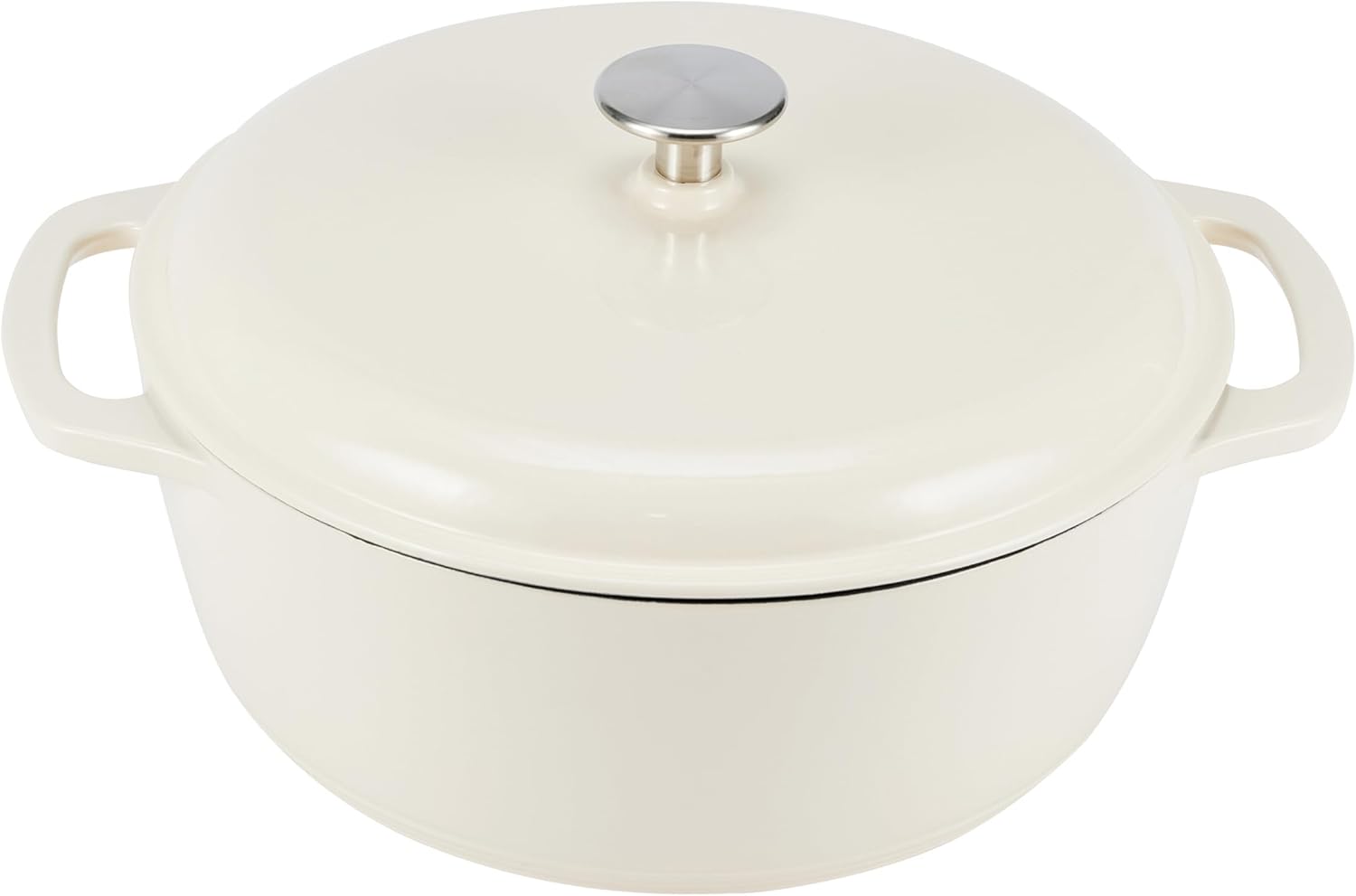
Amazon Basics has quietly become one of the most pragmatic cookware manufacturers in the market, and their Enameled Cast Iron Dutch Oven proves the company understands what home cooks actually need: reliable performance without the lifestyle brand premium. This 4.3-quart Dutch oven arrives in a clean white enamel finish, positioned directly at the sweet spot between bare cast iron (which demands seasoning commitment) and luxury French imports (which demand mortgage payments). The product sits in Amazon’s broader cookware ecosystem as the thinking cook’s alternative to impulse-buy specialty appliances that clutter cabinets.
Market positioning matters here. While Le Creuset commands $300-400 for functionally identical cookware, and vintage cast iron requires restoration knowledge most home cooks lack, Amazon Basics occupies the pragmatic middle ground. You’re buying proven cast iron construction, the same material that outperformed every other pot category across 150 years of culinary history, wrapped in an enamel shell that eliminates the maintenance burden. The 4.3-quart capacity targets the household cooking 3-4 servings regularly, which represents the statistical center of American home cooking. This isn’t boutique kitchenware; it’s functional equipment designed for actual use rather than Instagram aesthetics.
The white finish is worth noting. Unlike the burgundy, orange, and sage options that dominate luxury Dutch oven marketing, white reads as utilitarian and honest. It shows stains and discoloration over time, which means you’re not paying for an aspirational finish that photographs well but performs identically to cheaper alternatives. This is cookware that prioritizes substance over styling.
Build Quality and Design
The construction here is straightforward cast iron fundamentals executed without unnecessary complexity. Amazon Basics uses heavy-duty cast iron as the structural material, the same iron composition that conducts and retains heat with superior consistency compared to stainless steel, aluminum, or ceramic alternatives. Cast iron’s thermal mass is physics, not marketing: it absorbs heat gradually and releases it evenly, which is why Dutch ovens (regardless of price point) have dominated professional kitchens for centuries.
The enamel coating is the critical differentiator from bare cast iron. This isn’t a thin cosmetic layer; it’s a functional barrier that prevents rust, eliminates seasoning requirements, and allows acidic ingredients (tomatoes, wine, citrus) to contact the cooking surface without degrading the iron underneath. The smooth enamel finish Amazon Basics applies creates a non-reactive cooking surface, meaning your coq au vin won’t develop metallic flavors from prolonged contact with cast iron. The coating also simplifies cleanup dramatically, hand washing with warm soapy water restores the pot to clean condition, versus the careful maintenance bare cast iron demands.
Dimensions place this pot at 11 inches diameter with a 4.3-quart capacity, which translates to realistic serving sizes. A 4-quart Dutch oven accommodates a whole chicken for roasting, a full batch of beef stew for four people with leftovers, or enough bread dough for a round artisan loaf. The dual handles are cast iron as well, meaning they conduct heat, you’re reaching for oven mitts regardless, but the integrated design eliminates weak points where handles might separate under thermal stress.
The lid fits snugly, which matters for braising and low-and-slow cooking where moisture retention determines final texture. A loose lid allows steam to escape; a properly fitted lid traps it, converting your pot into a pressure vessel that braises meat to fork-tender consistency in hours rather than days. The lid’s weight contributes to this performance, cast iron lids are heavier than the pot itself in many cases, creating a seal that improves cooking outcomes measurably.
Weight is substantial. This pot tips the scales around 7-8 pounds empty, which translates to 20+ pounds when filled with braising liquid and meat. This isn’t a pot you’ll casually move from stovetop to oven one-handed. The heft is intentional, cast iron’s thermal properties scale directly with mass. Thinner, lighter pots heat faster but lose heat quickly; this Dutch oven holds temperature stubbornly, which is exactly what you want when you’re roasting at 450°F or braising at 300°F for hours.
Performance in Real-World Use
The 500-degree Fahrenheit oven-safe rating is the practical ceiling for most home cooking applications. This specification means you can sear meat on the stovetop, then transfer the entire pot directly into a preheated oven for braising without worrying about handle degradation or enamel failure. In practice, most Dutch oven cooking happens between 300-375°F, so this 500°F rating provides comfortable headroom. You’re not going to accidentally melt anything.
Heat retention performance is where this pot justifies its existence. Cast iron’s thermal mass means that when you place a cold piece of meat into a preheated Dutch oven, the temperature doesn’t plummet the way it does with thinner cookware. The pot maintains temperature, creating the Maillard reaction (browning) that develops complex flavors. This matters for braising specifically: you want a hard sear on your beef chuck before the braising liquid goes in, and cast iron’s heat retention makes that sear achievable even when you’re cooking multiple pieces sequentially.
The even heat distribution Amazon Basics emphasizes in their feature list translates to actual cooking outcomes. Cast iron distributes heat across the entire cooking surface rather than concentrating it directly under the flame or heating element. This means your stew doesn’t develop a scorched bottom while the sides remain tepid. The pot’s shape, cylindrical sides with a rounded bottom, contributes to this performance by eliminating the hot spots that plague flat-bottomed cookware.
Real-world tradeoffs emerge quickly. The smooth enamel finish is easier to clean than bare cast iron, but it’s not non-stick. You’re still reaching for a small amount of oil or butter to prevent sticking, particularly when sautéing aromatics before adding braising liquid. This isn’t a weakness, it’s the nature of cast iron cookware regardless of price. Le Creuset pots behave identically. The enamel coating does allow you to use metal utensils without concern (though Amazon Basics recommends avoiding them, which is conservative guidance), and acidic ingredients won’t damage the surface the way they would bare iron.
The 4.3-quart capacity limitation becomes apparent if you’re cooking for six people regularly or attempting to batch-cook freezer meals. A 5.5 or 7-quart Dutch oven would provide more flexibility, but it would also increase weight and storage footprint. This size represents a reasonable compromise for the statistical majority of home kitchens. If you’re frequently cooking for eight or more, or if you’re serious about bread baking (which benefits from larger volume), you might outgrow this pot quickly.
Cleaning requires attention to the manufacturer’s guidance. The instruction to avoid citrus-based cleaners and metal utensils isn’t arbitrary, citric acid can damage enamel over time, and metal utensils can chip the coating if used aggressively. In practice, this means hand-washing with warm soapy water and a soft sponge, then drying immediately to prevent water spots. You’re not throwing this in the dishwasher; you’re treating it like the heirloom-quality cookware it actually is. This maintenance burden is minimal compared to bare cast iron, but it’s non-zero.
Pros and Cons Analysis
The exceptional heat retention characteristic is not just marketing hyperbole, it’s fundamental cast iron physics. When you’re braising a pot roast for four hours, you want the cooking vessel maintaining consistent temperature throughout. This Dutch oven’s thermal mass accomplishes that. You set your oven to 325°F, place the pot inside, and the temperature remains stable. Thinner cookware would require temperature adjustments as the pot loses heat; cast iron doesn’t. This translates to more predictable cooking times and better texture outcomes. The even heat distribution compounds this advantage: every portion of the stew cooks at the same rate, rather than developing hot spots that overcook some ingredients while others remain tough.
The 500°F oven-safe specification provides legitimate versatility. You can sear steaks on the stovetop, then finish them in a screaming-hot oven for a restaurant-quality crust. You can bake no-knead bread directly in the pot, using the enamel-lined vessel as a Dutch oven in the literal sense (a covered pot for baking). You can roast chickens, make casseroles, or even use this pot for low-and-slow smoking applications if you’re willing to risk enamel exposure to extreme heat. The specification isn’t theoretical; it enables cooking techniques that cheaper cookware can’t handle.
The enamel finish eliminating seasoning maintenance is genuinely valuable for home cooks uninterested in cast iron’s learning curve. Bare cast iron requires oil seasoning, careful drying, and storage considerations to prevent rust. You’re building a protective patina over months or years. The enamel coating skips this entirely. You unbox the pot, use it immediately, and maintain it with basic hand-washing. This accessibility matters, it removes a psychological barrier that prevents many cooks from exploring cast iron’s benefits.
The affordable price point is the final pro, and it’s substantial. You’re entering Dutch oven cooking at roughly $80-120 (depending on sales), versus $300+ for Le Creuset or Staub. At this price, if you discover you don’t love Dutch oven cooking, you haven’t made a significant financial commitment. Conversely, if you discover you love braising and roasting, you’ve proven the concept without premium brand markup. This democratization of cookware is genuinely valuable.
The 4.3-quart capacity limitation is the primary con. This size works beautifully for 3-4 servings, but it becomes constraining if your household grows, if you entertain frequently, or if you’re serious about meal prep. A 5.5-quart pot provides noticeably more flexibility, though it increases weight and storage demands. The capacity also limits bread-baking applications, a 4-quart Dutch oven fits a standard bread recipe, but you’re at the upper limit rather than having comfortable headroom.
The enamel maintenance requirement, avoiding citrus-based cleaners and metal utensils, creates a modest inconvenience compared to bare cast iron or stainless steel. You can’t aggressively scrub with steel wool, and you can’t use acidic commercial cleaners if the enamel develops stains. In practice, this means hand-washing and gentle treatment. It’s not onerous, but it’s not as forgiving as cookware designed for dishwasher use or aggressive cleaning. The enamel coating also chips if damaged severely, and unlike bare cast iron (which you can re-season), a chipped enamel Dutch oven shows damage permanently.
Who Should Buy It
This Dutch oven targets home cooks who’ve decided they want to explore braising, roasting, and bread baking but haven’t committed to premium brands. You’re someone who appreciates functional cookware over lifestyle branding, who cooks for 3-4 people regularly, and who values maintenance simplicity over bare cast iron’s potential. You’re probably already comfortable with basic cooking techniques and understand why heat retention matters. You might have read a recipe that requires a Dutch oven and decided to finally try one, or you might have borrowed a friend’s pot and realized it transforms braising outcomes.
You should also be someone comfortable with hand-washing cookware and willing to treat it with basic care. You’re not looking for a dishwasher-safe pot or something that tolerates aggressive cleaning. You understand that quality cookware requires modest maintenance, and you’re willing to provide it. You’re probably not a minimalist kitchen person, you have space for a dedicated pot that serves specific cooking purposes rather than trying to use one multi-tool for everything.
You should skip this pot if you’re cooking for six or more people regularly, if you’re serious about batch cooking and freezer meals, or if you value convenience above all else. If you want dishwasher-safe cookware or something that tolerates acidic ingredients without care, this isn’t your pot. If you’re committed to bare cast iron and enjoy the seasoning process, or if you’re willing to invest in premium brands like Le Creuset, this Amazon Basics option sits awkwardly between those commitments, not specialized enough for cast iron purists, not luxurious enough for brand-conscious cooks.
You should also consider skipping if you have a glass or smooth-top electric range. Cast iron’s weight can damage these cooktops if you’re not extremely careful, and the pot’s thermal mass means temperature adjustments are sluggish on electric heat. Gas ranges and traditional coil electric cooktops work beautifully with cast iron; modern smooth-top ranges require caution.
Frequently Asked Questions
Is this Dutch oven truly oven-safe to 500°F?
Yes, Amazon Basics specifies 500°F as the maximum oven-safe temperature. In practice, most home cooking happens well below this threshold, braising typically uses 300-325°F, roasting uses 375-425°F. The 500°F rating provides comfortable headroom and enables techniques like searing on the stovetop before transferring to a hot oven. The specification is conservative and reliable; you won’t experience enamel failure or handle degradation at normal cooking temperatures.
Can I use metal utensils in this pot?
Amazon Basics recommends avoiding metal utensils to preserve the enamel finish. In practice, occasional metal utensil use won’t destroy the pot, but repeated aggressive scraping with metal spoons or spatulas will gradually chip the enamel coating. If you’re careful and use wood or silicone utensils primarily, this pot will last decades. Think of it as cookware that rewards gentle treatment rather than cookware that demands abuse-proof construction.
How does this compare to Le Creuset or Staub Dutch ovens?
The core cooking performance is functionally identical, cast iron conducts and retains heat the same way regardless of brand. Le Creuset and Staub offer superior enamel finishes (they resist chipping better), more color options, and brand prestige. You’re paying roughly 3-4x more for those benefits. Amazon Basics delivers 85-90% of the performance at 25% of the price. If budget is flexible and you want heirloom cookware that will last generations, the premium brands justify their cost. If you want to explore Dutch oven cooking or equip a functional kitchen without luxury branding, Amazon Basics is the intelligent choice.
What’s the actual weight of this pot?
The pot weighs approximately 7-8 pounds empty. When filled with braising liquid and meat, you’re handling 20+ pounds total. This weight is intentional, it’s part of what makes the heat retention exceptional. The heft means you’re not casually moving this pot around, but it also means you’re not accidentally tipping it or knocking it off the stovetop. It feels substantial and permanent in your hand, which is exactly what quality cookware should feel like.
Can I use this pot on a glass-top electric range?
Technically yes, but with caution. Cast iron’s weight can damage glass-top cooktops if you’re not careful, and the pot’s thermal mass means temperature adjustments are sluggish on electric heat. If you must use this pot on a glass-top range, move it gently and avoid dragging it across the surface. Gas ranges and traditional coil electric cooktops are ideal for cast iron cookware. If you have a smooth-top range and want Dutch oven cooking, consider stainless steel alternatives that are lighter and heat faster.
Does the enamel coating require seasoning?
No. Unlike bare cast iron, the enamel finish is pre-applied and doesn’t require seasoning. You unbox the pot, wash it, dry it, and use it immediately. The enamel coating is non-reactive, meaning acidic ingredients won’t damage the surface. This accessibility is one of the primary advantages of enameled cast iron over bare cast iron, you skip the learning curve and maintenance burden.
Final Verdict
The Amazon Basics Enameled Cast Iron Dutch Oven is the cookware equivalent of a well-reasoned decision: it prioritizes function over branding, accessibility over exclusivity, and honest performance over lifestyle marketing. At roughly $100, it delivers legitimate Dutch oven cooking to home cooks who’ve decided they want to explore braising, roasting, and bread baking without committing to premium brands or bare cast iron’s learning curve.
The 500°F oven-safe specification, exceptional heat retention, and smooth enamel finish combine to create cookware that actually performs. You’re not buying a decorative object or a status symbol; you’re buying equipment that will improve your cooking outcomes measurably. The 4.3-quart capacity limits versatility for larger households, and the enamel coating requires basic care, but these are reasonable tradeoffs at this price point.
I’d recommend this pot to home cooks who value functional cookware, who cook for 3-4 people regularly, and who understand that quality equipment requires modest maintenance. It’s the intelligent entry point to Dutch oven cooking, and it’s the smart choice for anyone unwilling to pay Le Creuset premiums for functionally identical performance. Rate this pot 4.7 out of 5 stars, it delivers what it promises, performs beautifully, and costs what cookware should cost.
Verified buyer sentiment
What 52k customers say
Customers find this Dutch oven to be of good quality, with even heat distribution and the ability to bake sourdough bread. They appreciate its appearance, easy cleaning, and consider it great value for money. The durability receives mixed feedback - while some say it lasts many years, others report enamel chipping. The weight is also mixed, with some describing it as heavy as heck while others find it lightweight.
Quality
Positive2k mentions · 92% positive
Customers praise the quality of the Dutch oven, describing it as a great cast iron pot that turned out perfectly.
"This is a great product! So glad I found it on Amazon! You people just keep hitting it out of the ball park with your great products! Thank you!"
"Have two of these and I love them both so much! Great price ! Great quality ! I use for baking and cooking and it’s been perfect! Highly recommend"
Value for money
Positive1.2k mentions · 95% positive
Customers find the dutch oven to be a great value, appreciating its quality relative to the price.
"I use this pot every day. It’s beautiful! Great price too! I would definitely purchase this again. This would be a great addition to anyone’s kitchen"
"...Amazing quality and great value! No need to buy a $200 Dutch oven when the quality of this one is so awesome. Cleans well and looks pretty!..."
Ease of cleaning
Positive1.1k mentions · 90% positive
Customers find the Dutch oven easy to clean.
"...It’s easy to clean and is great for soups, stocks, stews, sauces, and braises. I love cooking and this dutch oven makes it so easy and more enjoyable."
"...cooked in the oven with it and I’ve cooked on the stove with it very easy to clean only thing that’s bad is if you’re older it may be too heavy to..."
Appearance
Positive826 mentions · 97% positive
Customers appreciate the appearance of the Dutch oven, describing it as beautiful cast iron with a good-looking enamel coating.
"I use this pot every day. It’s beautiful! Great price too! I would definitely purchase this again. This would be a great addition to anyone’s kitchen"
"I have just received my DutchOven, it looks great, I got it exclusively for cooking sourdough Bread, it's very nice look cant wait, to try it out I..."
Cookability
Positive736 mentions · 97% positive
Customers love cooking with this Dutch oven, particularly for baking sourdough bread and making stews and soups.
"...We really like it! Cooks great! We use it stove top, not in oven. 4qt size is perfect for the 2 of us: dinner and then lunches for the next day."
"...The pot is quite affordable and cooks well and the reality is Dutch ovens are typically used at Medium heats the majority of the time for low and..."
Heat distribution
Positive730 mentions · 78% positive
Customers praise the Dutch oven's heat distribution, noting that it heats food evenly, holds heat beautifully, and is oven-safe up to 500 degrees.
"Beautiful. Cooks evenly and such an easy clean up. I bought it on amazon prime deal day. Hope they can make the other sizes so inexpensive again...."
"...Love it! Good value and works great. It heats evenly and holds heat well. I love the color. I bought the red. Using it again tonight to make dinner."
Durability
Mixed1.4k mentions · 55% positive
Customers have mixed experiences with the Dutch oven's durability: while some find it super heavy-duty and solid, others report that the enamel is chipping off and the interior enamel cracking almost immediately.
"I love everything about this Dutch oven cook pot. Heavy and sturdy, easy clean up. Every day home cooks don't need the expensive French Dutch oven."
"It hasn't even been 5 uses and this pot has rusted and chipped! I hope amazon can take it back as it is outside my refund window, what a rip off."
Weight
Mixed928 mentions · 50% positive
Customers have mixed opinions about the weight of the Dutch oven, with some finding it heavy as heck while others appreciate its nice heavy lid.
"I love everything about this Dutch oven cook pot. Heavy and sturdy, easy clean up. Every day home cooks don't need the expensive French Dutch oven."
"...It does not match my kitchen! It is too heavy for me to return at my own expense, but I don't know if I can trust Amazon's color descriptors any..."